We assess the most exciting and rarest legacy of Lin Fengmian.
Six rare colored ink paintings by Lin Fengmian, from the same collector, dedicated to Lin’s family in Meizhou, Guangdong are consigned to Xiling Yinshe Auction. Five have dates on the works, among which two are painted with colored ink on silk, dated 1929 and 1932 while Lin served as a principal in Hangzhou, and signed with ‘Xi Hu (West Lake)’ mark. The earliest work was painted in 1919 when he set to study overseas, with the seal recorded in Lin’s collection of seal impressions. Two were created in Hong Kong in 1939 during the wartime. The largest one is measured 205×81cm.
The six paintings represent the early stage of Lin Fengmian’s art life. They mark the beginning of his art career and drive the master forward to capture the essence of both Eastern and Western art. Xiling Yinshe 2020 Spring Auction wants to ask the charismatic pioneer of Chinese modern art: Do Hakka people never suffer from an identity crisis in the context of globalization? How can you blend the best of both Eastern and Western art? What kind of paintings can represent a certain period of your creation? Maybe we can find the answer in the six masterpieces.
Consignment for the 120th Anniversary of Lin Fengmian’s Birth
Works, Literature, Seminars
0571-87896760 yhdsb@xlysauc.com
Colored ink paintings on silk around the 1930s when Lin served as a principal
▲Xiling Yinshe 2020 Spring Auction | Modern and Contemporary Oil Paintings and Sculpture
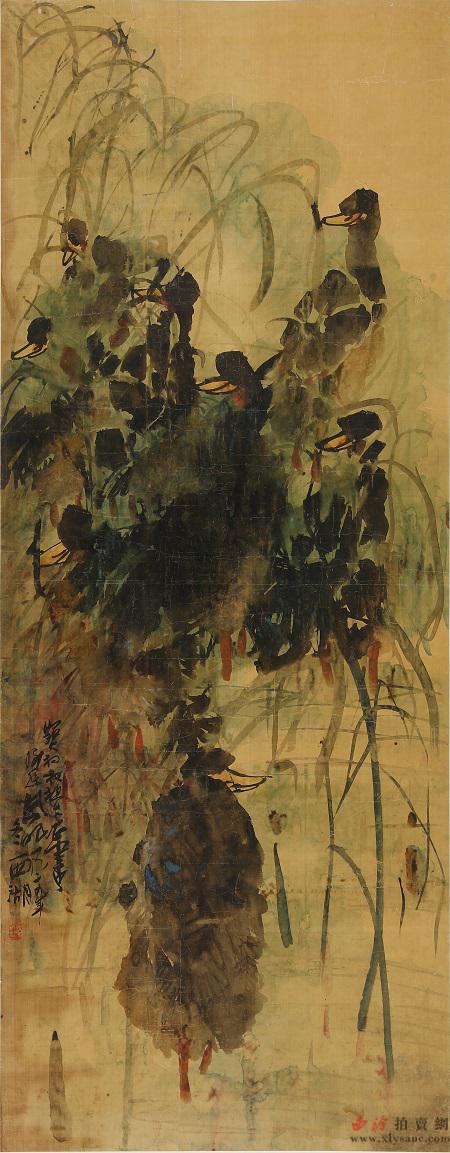
Lin Fengmian (1900-1991) Duck amid Grass
Colored ink on silk
Dated 1929
Signed with a seal of the artist
205×81cm
▲Xiling Yinshe 2020 Spring Auction | Modern and Contemporary Oil Paintings and Sculpture
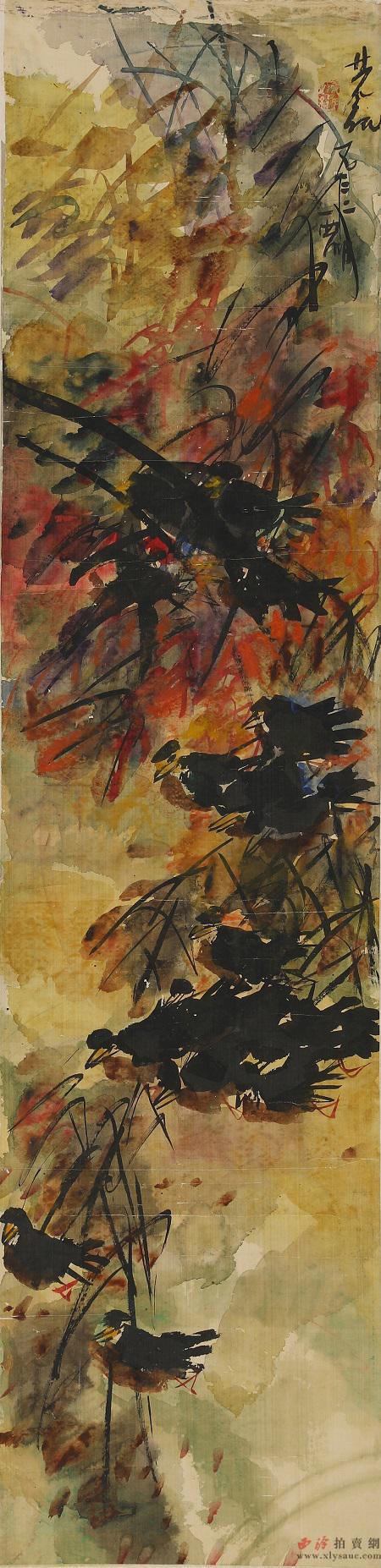
Lin Fengmian (1900-1991) Sparrows
Colored ink on silk
Dated 1932
Signed with a seal of the artist
165.7×40.5cm
Lin’s creation in the 1920s-1930s was rather evolving. His painting was where the east and west met and melt, through which he found his personal style. Lin was dedicated to exploring what he learned in Europe by skillfully applying an emphasis on light and color. That is how he can fill the space of his painting with lights and reflect the irrepressible rhythms of life with decorative regions of color. Lin realized the importance of line drawing, especially the advanced theories of chromatology. Inspired by the color contrasting of Lingnan School, Lin Fengmain, in his early 30s, was able to creatively coordinate ink and color, presenting ardent but delicate paintings. What a virtuoso!
Silk is the most culture-loaded fabric. Threads are woven in crosses, making the fabric uneven, forming a unique sense of beauty when combined with brush strokes. The glossy fabric adds to the light of the paintings. Lin made freehand brushwork with colored ink on silk, bold and expressive. These masterpieces symbolized the art of the Republic of China period, getting rid of meticulousness and conformism.
Birds are the first to be painted in the colored ink works. Animals appeared in flocks and herds in this period (see also tigers in Sheng Zhi Yu ‘Eager to be Alive’). Like lions, birds have similar expressions as humans (for example, the bird that turns its head to the other side from its fellows). The painting is formed in an inverted triangle, just as Egret painted in 1930 and collected by Guangdong Museum of Art. Although created with traditional tools, this work is much larger than those hung in the dining room, making it more like a fresco. Inspired by Gao Qifeng and Lingnan School, Lin Fengmian applied a boneless method, Zhuangshui and Zhuangfen (adding water or color to the work to make it more vivid). He also gave priority to the composition of the painting, coordinating the composition with colors, shapes and lines.
At this time, Lin signed and inscribed in traditional Chinese calligraphy, thick strokes with little variation. The three characters are clearly separated. However, we can still spot the clue of wire signature from the reeds in the painting. The seal impression is also rarely seen. He may have this seal engraved to replace the one he made himself. At times, the artist drew the seal impression with red pigment, which is a breakthrough in the traditional painting process.
Liangyou Magazine published Five Chinese Paintings of Lin Fengmian in 1931, three vertical and two horizontal, themed as figures and animals, all with painted seal impressions. We can see from the five works that Lin has already begun his exploration of composition. Autumn and Landscape, among others, are consistent with the two Xiling Yinshe Auction acquired. This period can hardly see Lin’s colored ink works published or illustrated, let alone the authentic works.
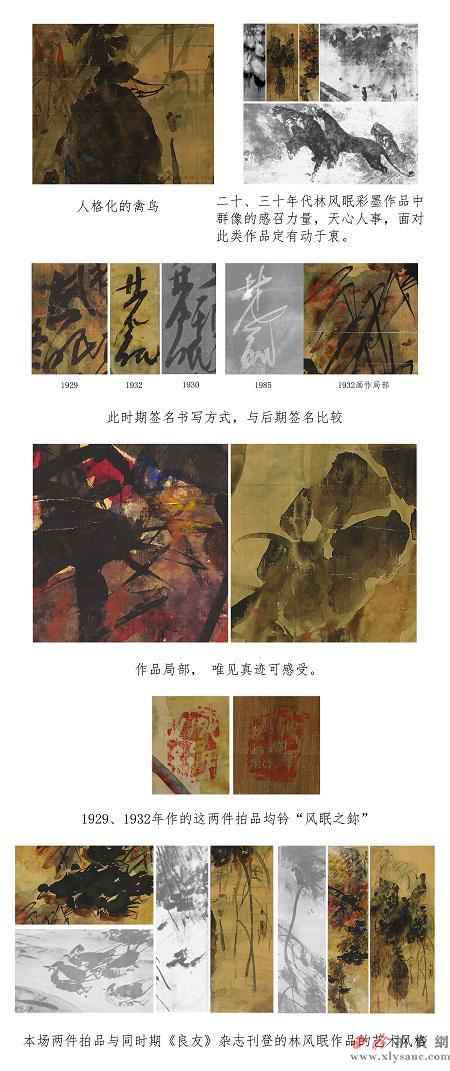
Signed with ‘Xiyang Shanren’ and a Seal Engraved by Lin Fengmian
▲Xiling Yinshe 2020 Spring Auction Modern and Contemporary Oil Paintings and Sculpture
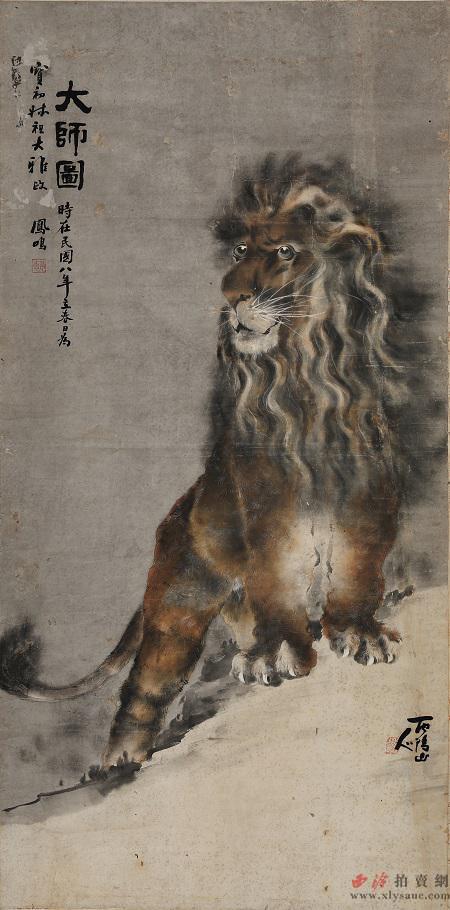
Lin Fengmian (1900-1991) Lion
Colored ink on silk
Dated 1919
Signed ‘Xiyang Shanren’ and ‘Fengming’ in Chinese, titled and dated, with a red and a white seal of the artist
Meiyu Magazine, established by Li Jinfa, recorded a collection of Lin Fengmian’s seal impressions in the early years. According to the issue number and illustration, these seals, including the two seals on the Lion, were used when Lin was in Meizhou Middle School.
The preface of the collection says ‘I am going to leave the school with nothing valuable left as gifts. So I plan to give my friends and classmates some seals engraved with my name, though imperfect. I want them to remember me whenever they see the seals.’ Except for three seals with notes, all were engraved by young Lin Fengming. Of the four engraved with ‘Xiaoyu’, one was noted ‘Jiayan Shoukan’. ‘Jiayan’ refers to Lin’s father Lin Bo’en. All the three seals from the father were engraved with Lin Fengmian’s name, ‘Lin Fengming’, Lin Shi’ and ‘Xiaoyu’. Therefore, we can guess that ‘Xiaoyu’ may be Lin Fengmian’s nickname, which is significant enough to be engraved repeatedly.
As Lin Fengmian’s calligraphic works in this period are hard to find, Lion is quite precious for the calligraphy on it. Though different in the script from seal impressions, the two are of the same temperament. As the painting is created for an older family member, the calligraphy is carefully and neatly written, as strong and ambitious as Wen Tonghe’s work. The collection of seal impressions are for his fellows, so the words are written in Zheng Banqiao’s style, which is rather distinctive. Lin Fengmian followed Gao Qifeng, who was the founder of The True Record, to draw lions. The magazine can often see lions and tigers painted on the cover. This painting was created in 1919 when Cai Yuanpei established the Chinese Aesthetic Education Community.
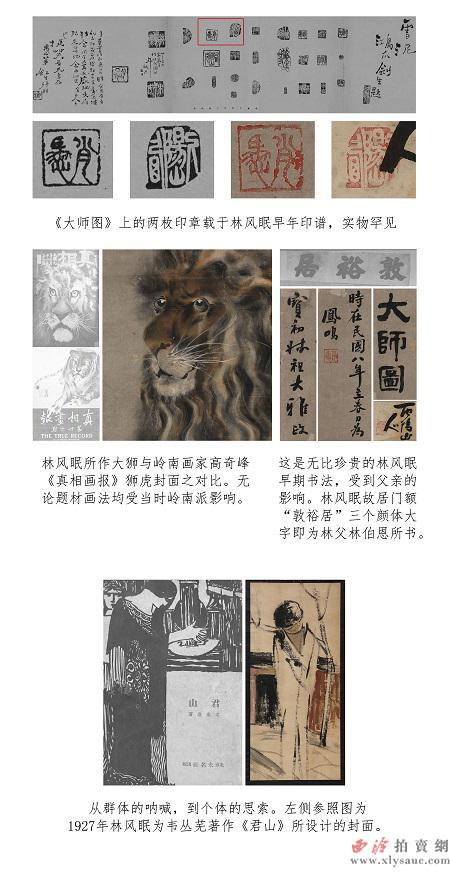
Figure Paintings with a Strong Theme
▲Xiling Yinshe 2020 Spring Auction Modern and Contemporary Oil Paintings and Sculpture
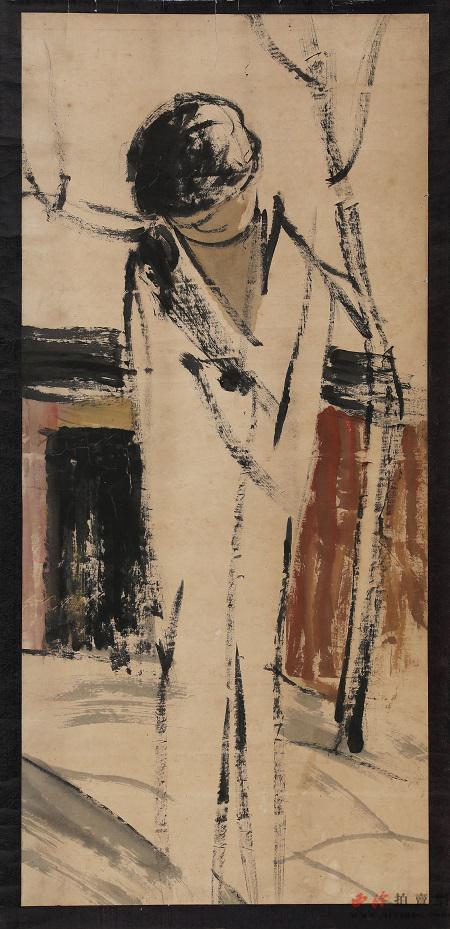
Lin Fengmian (1900-1991) Pondering
Colored ink on silk
132.3×60.3cm
This work, though with no date marked, is presumed to be created in the 1920s. The figure is at the center, which is rarely seen in vertical Chinese paintings. It is painted with thick ink and dried brush, mounted in black frame purposely, generating a feeling of imprisonment and restlessness. Therefore we can say that paintings in this period are with a strong theme, rare, unique and highly valued.
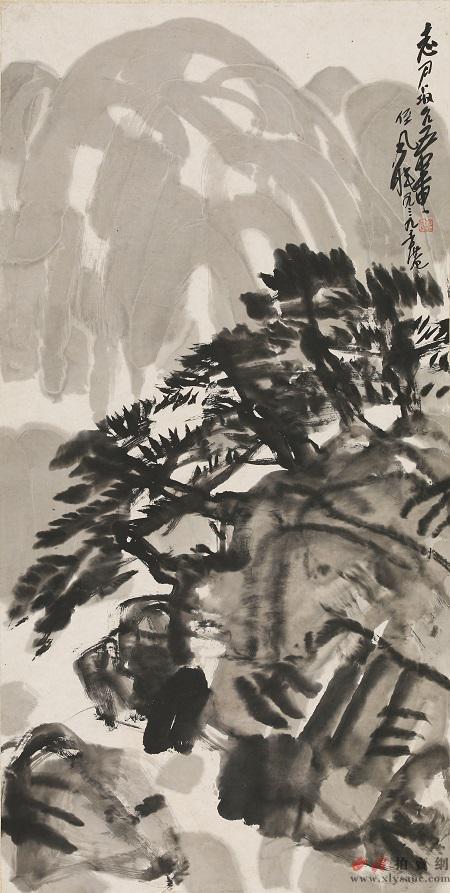
▲Xiling Yinshe 2020 Spring Auction | Modern and Contemporary Oil Paintings and Sculpture
Lin Fengmian (1900-1991) Ever-green Pine Trees
Ink on paper
Dated 1939
Signed with a red seal of the artist
136.5×68.3cm
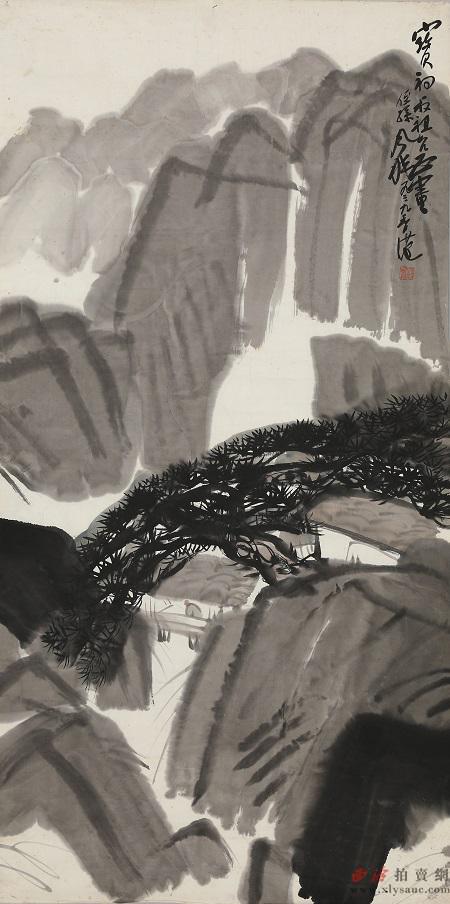
▲Xiling Yinshe 2020 Spring Auction | Modern and Contemporary Oil Paintings and Sculpture
Lin Fengmian (1900-1991) Divine Abode in Lingshan Mountain
Ink on paper
Dated 1939
Signed with a red seal of the artist
132.3×66.2cm
It was as early as 1932 when Kang Youwei initiated his opposition against the Chinese literati paintings by complaining about its disadvantages in his work Catalogues of Paintings Collected by Wanmucaotang, quote ‘The modern Chinese painting has greatly declined’. Kang’s such thoughts should not be just reckoned a painting theory but also a significant concept of the transformations that occurred around the early 20th century. It was a retro form combined with the characteristics of the paintings in Tang and Song dynasties and European classical realistic style. Such amalgamation of both was later reflected by the works of the masters like Xu Beihong.
Lonely pine trees, secluded pavilions and men who walked alone became more conspicuous in the landscape paintings created by Lin at that time, and whether these objects were related to the painter’s mood still remains unknown. And most of his later works like reeds and autumn sceneries are characterized as the depiction of various plants. He used inks and curves for the paintings, and even changed his inscription and signature style from round cornering strokes to square cornering ones, which is a bit different from his calligraphy featuring more arbitrariness in his later years. The seal is a typical one consisting of four characters ‘Lin Feng Mian Yin’. The manner of the distant mountain painting may be attributed to the inspiration of other ancient arts, and impacted by the conduct of Shanghai School which pursues a variety of changes by painting with old ink on impermeable Xuan paper. To be inspired by the historical culture for the modern art is what he learnt during his stay in Europe, and the accurate shapes drawn with thick ink in large areas make sure the precise expression of his abundant affection.
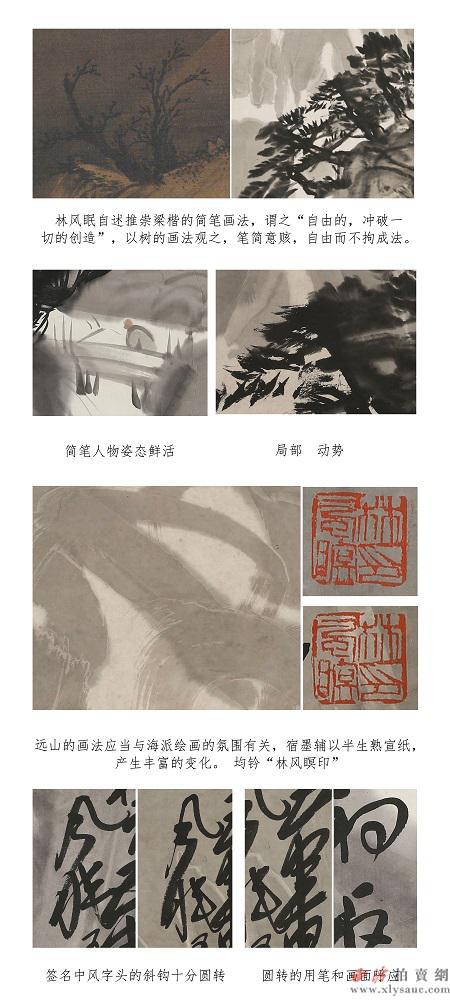
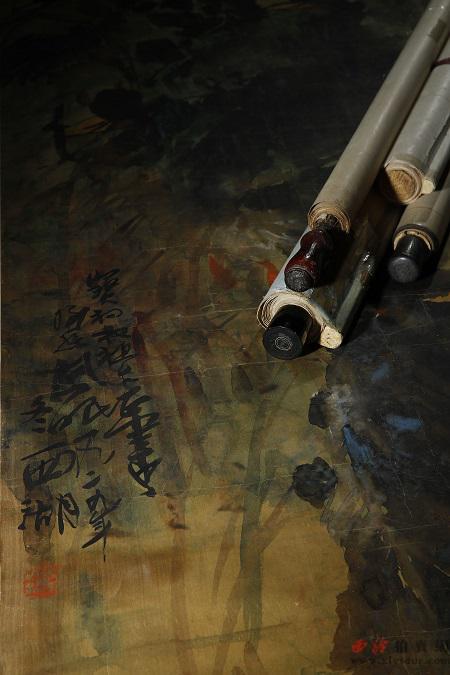
Hakkanese never hesitates to embrace globalization. We can see the work Lion painted in 1919 is a gift given by a younger generation to his elder from its respectful inscription. It is a gift showing not only the respect but also the great ambition of the younger generation. The works dedicated to the same elder share the same painting style and inscription. However, this behavior is generally deemed not to be respectful because it is similar to writing the elders letters in cursive script. But why Lin can do this again and again is possibly his unrestrained character or his insight into what the elder likes aesthetically.
So, it is incredible that the Hakkanese elders are more likely to accept novelties in painting style. Lin’s Hakkanese elders were brave, let alone the generation born during the Opium War, who were the first activists in the modern history of China. Their constant acceptance of the younger generation’s innovation and creation in various industries was far more important than the support in an economic way. Thus it’s really sad to see the attacks on Lin’s painting style in his later years. Among the supports from the elders, a more important one to Lin was from Cai Yuanpei. ‘The nature of painting is painting’, one of the well-known words by Lin Fengmian. In such a special era, Lin’s persistence in emphasizing the character of the painting itself in all fields like politics, economics, culture and national salvation is just out of his smartness and soberness.
As a painter and poet, why doesn’t he inscribe for paintings?
Lin Fengmian is absolutely a poet. He had been a friend of another poet Li Jinfa who was also a member of Tanli Poet Society since they were in Meizhou Middle School. But in his literary works, there are only two poems Yu Zhong Shi Er Shou and he also seldom made poems for his paintings. Two masterpieces that the author has ever seen so far are Sheng Zhi Yu made in 1924 and a long inscription made as description for a painting called Spring Intoxication published on Beijing News in 1926. Painting without inscription is a deliberate avoidance of the literariness that traditional literati paintings take advantage of to enrich the artistic conception of the paintings. So, we can find more and more Lin Fengmian’s works titled in a straightforward manner without any rhetoric or metaphor, which is obviously a pursuit of higher artistic level by touching people directly with pictures.
Compared to these works with inscriptions of both the artist and the person who was dedicated to, which will be auctioned by Xiling Yinshe Auction in this spring, the works from Lion to those painted with colored ink on silk around the 1930s, and the landscape paintings created during the war of resistance against Japan, the calligraphy of the inscriptions became more and more focusing on the consistency with the painting style. Lion is basically traditional in composition with space for inscription while its calligraphy is independent. But the works created later such as Ji Yi Tu and Sparrows are all characterized as the painting overlapped by inscription, especially the works Evergreen Pine Trees and Divine Abode in Lingshan Mountain which combined the painting and inscription so well that both became a part of each other but somewhat independent. And then, Lin’s works began to embrace the signature style of western paintings directly with delicate strokes and lines in different colors so that the signature was integrated into the whole picture.
Lin’s inscription is also low-profile as he does not mark time with ‘Tian Gan Di Zhi’ (the ten heavenly stems and twelve terrestrial branches) but the A.D. instead, which also implies his modernism. The Chinese characters ‘Xi Hu (West Lake)’ does not just refer to Hangzhou, but also Beijing National Art College, a utopia breeding the aesthetic education in the new era. It is thus clear that the poetry in Lin Fengmian’s paintings has been fully expressed without any necessity of literary description just because his aesthetic opinions and theories on painting has been presented in his articles and speeches. Along with the changes to the relationship between the pictures and inscriptions, the function of the inscription has been weakened, which just reflected Lin’s pursuit of perfection. From the inscriptions to signatures, it is not just about the changes in contents, but the pursuit of perfection and evolutions of aesthetic thoughts.
Did Lin Fengmian become more isolated?
The answer is definitely no. Lin’s oil paintings which were created at the same time as these paintings around the 1930s are all about humanity and salvation, as well as the consciousness about the world through pure art with a strong nationalism behind it. The change from the traditional Chinese literati painting style to the modern humanity needs theories. So, the true content correspondent to Lin’s paintings is not the inscription on the painting but his discussions and speeches made in the same period.
There are two major theories supporting Lin Fengmian’s art. One is the new cultural perspective attributed to the atmosphere of the Western modernism art, and the other is the thought of ‘popularization of literature and art’ advocated by the May 4th Movement and Cai Yuanpei’s concept of replacing religion with aesthetic education. The mentor in Europe suggested Lin visiting the Oriental Museum and the Museum of Ceramics in Paris to discover the East. From the cultural relics of anthropology, ethnology and folklore, the visual consciousness in his childhood was proved theoretically and his visual stimulus was echoed by the fauvism impressionism. He found more value in oriental art and integrated his national consciousness with the art. Due to Lin’s persistence in the independent aesthetics of painting and exploration of modern art, these works painted in Lin’s earlier years present a kind of power of declaration for globalization, breaking the Europeans’ limitation on how to look at the oriental. As a master, Lin Fengmian’s greatness lies in the probe in such a paradigm shift and discursive formation.
If we don’t see the difference between the interest and belief, we cannot enter the world of Lin Fengmian, Thanks to his abandonment of the Chinese literati painting style, traditional theory, scholar’s taste and even the identity of a literati, we are able to see his stance and attitude under a great cultural background.
Let’s retrospect Lin’s visual consciousness: Paintings of Jieziyuan, the color on his mother’s clothes of Yao Ethnic Group style, the curves and lines of foliage engraved on stones by his father (a traditional stonemason), paintings published on the The True Record edited by Gao Qifeng, the eclectic painting, the echo to the visual stimulus agitated by fauvism and impressionism in Paris, Liang Kai’s calligraphy and painting, lines of the pattern on ‘Cizhou’ and ‘Ding’ ceramics, Chinese shadow play and so forth. He and Li Jinfa and Lin Wenzheng are friends sharing similar interests and purposes, and Lin’s uncles whom the paintings were dedicated to imply the genes of the deep culture. With this, Lin discovered a new way beyond the traditional Chinese literati painting style and new literati painting style as well as the Lingnan School and Okakura Tenshin’s oriental art theory.
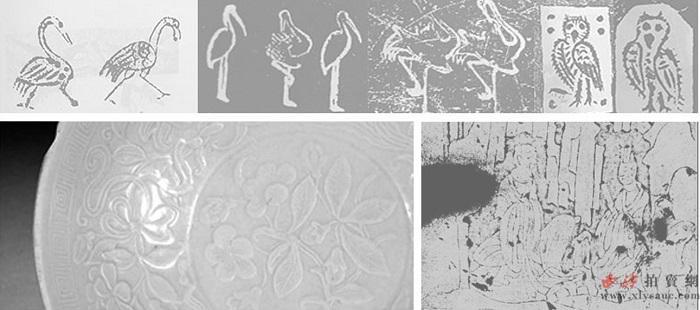
Partial examples of Lin Fengmian’s visual consciousness: patterns on the brick of Han dynasty, patterns on the ‘Cizhou’ and ‘Ding’ ceramics, traditional lines engraved on stones in his childhood.
‘One Bird Worth Eight Hundred Dollars’, a headline on a piece of newspaper in 1931 has drawn great attention and in the following Shanghai Art Club Exhibition, Lin Fengmian’s three ink paintings beat all the western counterparts with six birds valued as much as five thousand dollars! What about one lion, dozens of birds, two figures and two mountains which will be auctioned by Xiling Yinshe Auction? In art history, Lin is always an introverted, quiet, lonely and sad man. But these paintings, after one-decade survival and witnessed on the 200th anniversary of his birth, also imply Lin was vigor in his prime. ‘White cheeks, piercing eyes with elegant manners like Byron and Keats’, the author Sun Fuyuan’s younger brother Sun Fuxi excitedly wanted to offer the West Lake to Lin Fengmian on behalf of all the people of Zhejiang province! ‘I am glad the spring has come to the West Lake. So many people are looking at you and anxiously waiting for you and the great works by you and other masters from the academy of art. Besides science and philosophy, art also imbues youth in confusion with great and strong power. The West Lake will inspire you more and the youth will nourish your inspiration to mature’, Sun wrote so in the Offer the West Lake to Mr. Lin Fengmian published in the newspaper in 1928.
Young people, the fight for art is not yet over.
By the West Lake once upon,
Met as a youth,
Six bridges,
Lotus breeds,
Distant birds.
By the Xiling Society again,
Unveiling the truth,
Wind weakens (Fengmian),
Breeze stops (Fengming),
Bird chirps (Fengming).